
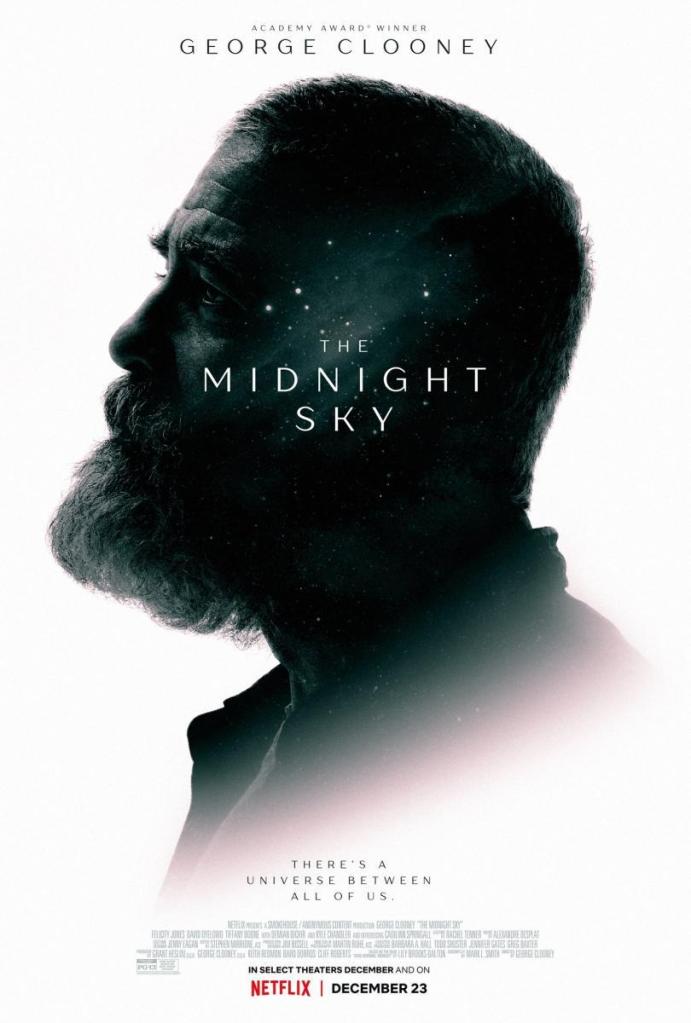
I have just seen a film. A magnificent film. A true work of innovation, given to us by none other than one of our most beloved living actors.
On top of his stellar acting career, king of cool George Clooney has also directed several films, often quite good ones, sometimes even great ones such as Good Night and Good Luck, one of my personal favorite films of all time. But today I am not here to simply review a film, for mere review cannot do this work justice. I am instead here to spin a sonnet, one dedicated to the Netflix masterpiece; The Midnight Sky.
Mr. Clooney isn’t just a good director, but an inspirational one. For one, he sometimes eschews the traditional three-act structure that such plebeians as Steven Spielberg or Martin Scorsese tend to be bound by. This was done well enough in Good Night and Good Luck, which, being a film about conversations and rhetoric, itself kept a conversational pace. The Midnight Sky, however, further innovates with the bold decision to replace the three-act structure with…absolutely nothing.
Experimenting with pacing? HA! Try no pacing at all. Take that, Kubrick you hack!
What will truly touch the audience and put them in tune with the plight of the characters is to make the film a succession of things just kind of happening, going from introspection to action without so much as a facsimile of rhyme or reason.
Oh sure, the movie starts traditionally enough, with George Clooney’s character alone in an arctic base, maybe the last man in the world waiting to die. It is a setup that begs for both an interesting and unique character piece as well as any actor/directors dream, the kind of self-indulgence that the Oscars would trip over themselves to award. And it would be earned, it is a masterpiece in the making. Some would say it is a crime to waste such a cool idea for something more tried and true.
But Clooney doesn’t settle for taking advantage of a unique and interesting premise. Instead, he quickly adds a little girl, turning this from a movie about the sole remaining human allowing himself to waste away to a movie about a grizzled, tortured man rediscovering his humanity by becoming the father figure of a child of whose innocence is waning in this dead world.
Because that…

Has never…
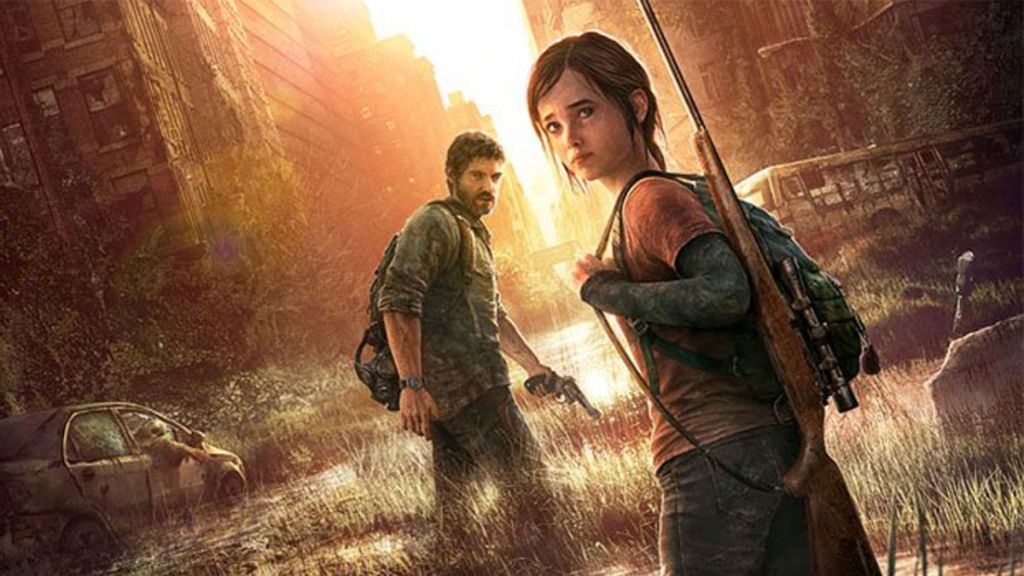
Been Done…
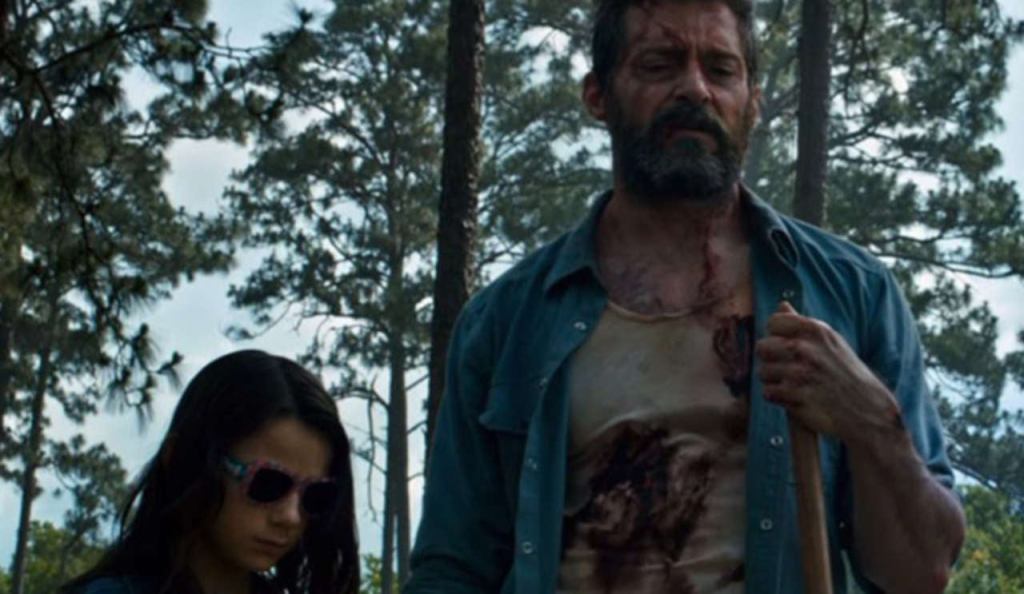
BERFORE!
…I’m sure it’s brilliant this time.
So anyway, Clooney and the little girl have to journey through the arctic to contact a space exploration vessel and tell them not to come back to Earth, which is ravaged by radiation. Why is it ravaged by radiation? Some lesser films would give a quick explanation, maybe tie it in with the character’s plight, like perhaps it was a result of man’s hubris and the exploration vessel needs to make a new start, or maybe it was some random cataclysmic event, the Earth itself basically getting a terminal disease just like Clooney. Fast, efficient and effectively depicting the global stakes through the arc of the characters.
SOME movies would do this. But in another brilliant innovation, the movie instead simply doesn’t explain at all what happened. A cynical person might decry this as naked apathy on the part of the storyteller, but I choose to believe there is some grand point being made about the futility of details. Humanity is done, the Earth is uninhabitable, that’s all you need. It couldn’t possibly be laziness. That’s an absurd idea.
Speaking of the exploration vessel, here we get a full cast of top level Hollywood talent. We get more bold storytelling decisions, as long stretches of movie are spent with the characters having long conversations that communicate absolutely nothing to the audience. Again, many films would use dialogue to build empathy with the characters and let us know who they are so we can want to see them succeed in possibly starting the new humanity. But we’re here to innovate not reiterate, so instead the characters remain one dimensional all the way through, given maybe one character trait each so that their nonsensical decisions at the end can make sense.
Sure, maybe Kyle Chandler and Demián Bichir’s characters returning to Earth to despite knowing they’ll die a horrible death SEEMS nonsensical, but they kept rambling about their families so it makes sense, yeah?
In fact, there is another layer to this; one could say the people on the ship reflect the audience, with Felicity Jones and David Oyelowo being the people who see the genius of this film and leave ready to start a whole new life, unable to go back to where they used to be, such is the enlightenment that comes with this work.
Meanwhile, Kyle Chandler and Demián Bichir represent the rest of the audience who just don’t get it, opting to die a slow burning death from radiation poisoning because that sounds better than watching this ouroboros of tedious nothingness for even one more second. Not that I could relate, obviously.
The layers of subversion are without limit. Federico Fellini? More like Federico FAILini amirite?
It should also be noted that Clooney has clearly learned from his betters. He notably starred in Gravity, made by top-of-the-line filmmaker Alfonso Cuarón, and in a lengthy sequence emulates that movies thrilling disastrous spacewalk. Not only does Clooney start the sequence with an endearing scene of all the characters singing a full pop song that surly would not make any audience member yearn for the sweet embrace of death, but then comes the real innovation. See, where Gravity held itself to normal standards by having it’s sequence be full of nails-in-your-seat tension and thrills, Clooney chooses to instead have Astronauts stuck in space avoiding deadly debris have all the thrill and tension of nearly stubbing your pinky toe on a rock but then you don’t. But then you find out you did stub your pinky toe just a little. And that’s a bummer.
See, it’s like real life. What’s more thrilling than real life?
Mr. Clooney also looks to the career of one M. Night Shyamalan, surly a director worth emulating, as he ends his film on not one, but two twists. Ah, but you see in the early days of Shyamalan’s career he would use plot twists to further the character based stories he was telling, giving a final revelation that recontextualized the entire story and hitting Bruce Willis (for it was always Bruce Willis) with devastating information that changed the context of everything he had learned from the rest of the story. It was a final jolt to the audience that didn’t just surprise them, but made the whole story one to remember forever.
Since this method has been so thoroughly established, The Midnight Sky eschews it, instead not only making one twist both insultingly predictable and yet landing with such a lack of impact or consequence that you wonder why they even bothered having it, but a second twist that actively detracts from the movie, making half of Clooney’s actions now completely pointless. And as I said these scenes were already big bags of nothing to begin with, so with one reveal Clooney successfully manages to make half his film actually less than nothing. The absolute mad lad. François Truffaut is swooning in his grave.
All of these elements come together to make The Midnight Sky one of the greatest works of subversive genius in the history of science fiction.
I mean, it must be, right?
Because if it isn’t than this would be one of the most insulting movies I’ve ever seen in my life. A vacuous void of a film that revels in it’s own lack of…anything, really. The total lack of characterization, theme or message, the refusal to take advantage of the genuinely interesting ideas presented in favor of overused cliché’s presented with great importance but zero innovation or interest. It would be all the self-important emptiness of a Zack Snyder movie but with all the excitement of an episode of Murder She Wrote.
And that just can’t be the case. I wasn’t being sarcastic when I praised Clooney, he has made some great and innovative films, he couldn’t have possibly made on the most unimaginably awful waste of potential in a sci-fi movie I’ve seen since Prometheus.
Right?
 The Right Side of Dan’s Brain
Well written as always
LikeLike